People Don’t Want AI Music
For years, AI executives promised a frictionless future. This summer, they got the opposite: Boos. Eye rolls. Middle fingers.
At the 2026 college graduation ceremonies of Middle Tennessee State, Arizona State and University of Central Florida, executives delivered commencement speeches about the glories of AI. “AI will touch everything,” said former Google CEO Eric Schmidt. Graduates booed. “AI is the next industrial revolution,” said real estate executive Gloria Caulfield through wolf’s teeth and dangling earrings. Graduates booed. Among these hapless execs was Taylor Swift producer Scott Borchetta, who squinted at a shimmering sea of college kids in cap and gown, and declared that AI is the future of music.
These aren’t one-off incidents. The data backs it up. And when it comes to the arts, ordinary people’s views on the topic are clear.
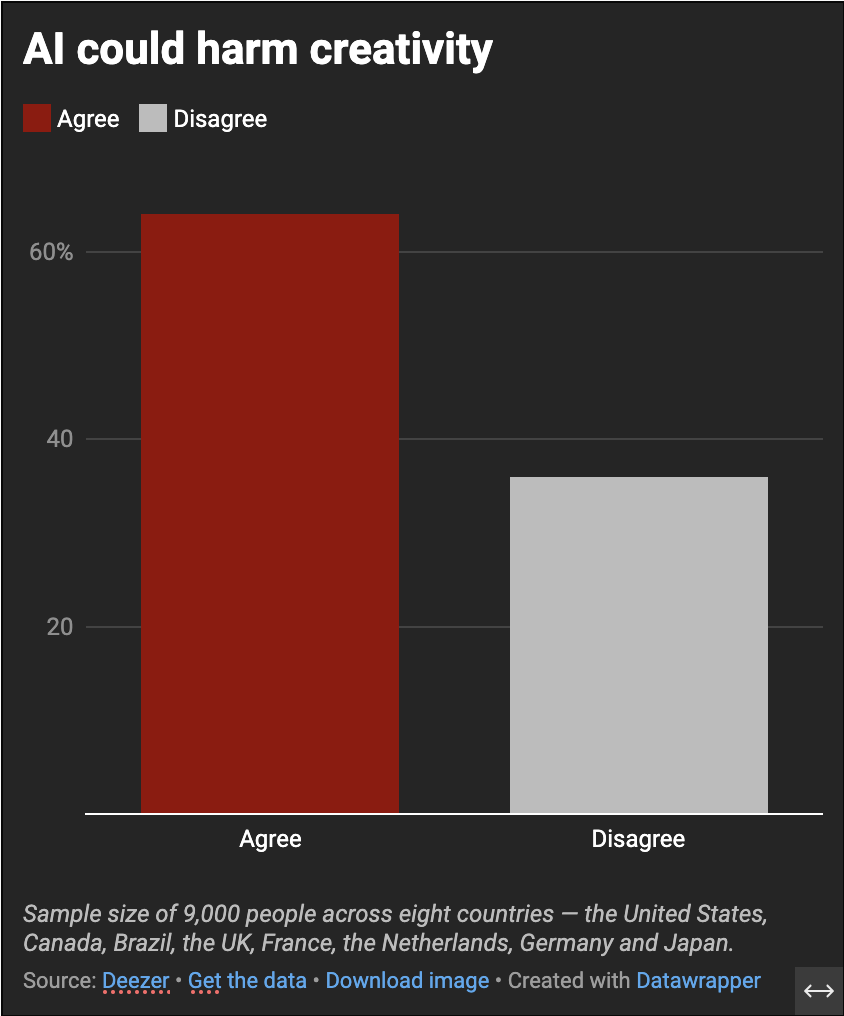
A 2025 survey by music streaming platform Deezer polled 9,000 people across eight countries to find out what people really think about AI in music.
First, the unsettling part: when people are asked to tell the difference between AI-generated songs and human-made songs, most can’t. In the survey, listeners heard three tracks and had to pick which were fully AI-generated — 97% failed.
But here’s the thing: when people know that a song is AI-generated, they tend to hit “skip.”
On Deezer, where they alert listeners if a song is AI-generated, AI tracks make up 44% of uploads, but only 1–3% of streams. So the platform is flooded with AI songs, but no one is listening.
Nearly two-thirds of listeners fear AI will drain creativity from music production, and 51% think it will flood streaming platforms with more low-quality, generic tracks.
Another survey — run by journalist Deni Ellis Béchard and neuroscientist Gabriel Kreiman for Scientific American — zoomed out to all creative media: music, movies, novels, paintings. Again, the verdict on AI was blunt.
“The results were striking,” the authors wrote. “The majority of people who participated disliked the idea of AI-generated art and held the view that human art has an emotional depth that machines either can’t or shouldn’t reproduce.”
The authors designed a clever thought experiment. Respondents named their favorite works — J. D. Salinger’s The Catcher in the Rye; van Gogh’s The Starry Night; Hamilton; songs by the Beatles, Metallica, Cat Stevens. Then they were asked to imagine those exact works were made entirely by AI. More than 67% said they would like the art less.
The romantic view of music is that represents artists’ souls — and I’m sympathetic to that idea. But for those who care deeply about music — and may also want to make a living at it — the truth may be less romantic and more practical: Fans don’t want AI.